(1) an attempt at exhausting a place at Rice
Date: 2020.5.21
Time: 7:40-8:40 am
Location: McMurtry College Room 420
Weather: cloudy at first, and then sun rises, partly windy
Time: 7:40-8:40 am
Location: McMurtry College Room 420
Weather: cloudy at first, and then sun rises, partly windy
Very quiet, wouldn’t expect any pedestrians or cars at this moment.
What I see on the ground level: a quad with seven trees--one is one-floor high, four are two-floor high, one is four-floor high, and one is five-floor high. In the middle of the quad, there are several grills and three wooden hexagonal tables.
On my eye level: a range of rooms, each with five windows, mirroring the distribution of my side. Right opposite of my room on the third floor, the curtains are accidentally curled up. And I see a pair of legs lying on the bed. Only legs, no other parts of the body. There is a black round shape behind the legs, which makes me feel like the person is crawling downwards from the edge of his bed.
Ground floor, a man wearing a grey T-shirt walks out of the building with a suitcase.
Two birds fly passed, casting shadows on the brick facade.
Wind blows through the trees, causing slight movements of leaves.
Two cleaning people come into the room next to the room I just observed. A woman in blue, a man in white. They put on the mattress, mop the floor, and start cleaning the windows. Finally, they curl down all the curtains and I lose them in sight.
The legs are still there.
What I see on the ground level: a quad with seven trees--one is one-floor high, four are two-floor high, one is four-floor high, and one is five-floor high. In the middle of the quad, there are several grills and three wooden hexagonal tables.
On my eye level: a range of rooms, each with five windows, mirroring the distribution of my side. Right opposite of my room on the third floor, the curtains are accidentally curled up. And I see a pair of legs lying on the bed. Only legs, no other parts of the body. There is a black round shape behind the legs, which makes me feel like the person is crawling downwards from the edge of his bed.
Ground floor, a man wearing a grey T-shirt walks out of the building with a suitcase.
Two birds fly passed, casting shadows on the brick facade.
Wind blows through the trees, causing slight movements of leaves.
Two cleaning people come into the room next to the room I just observed. A woman in blue, a man in white. They put on the mattress, mop the floor, and start cleaning the windows. Finally, they curl down all the curtains and I lose them in sight.
The legs are still there.
More winds.
A bird flies through the quad.
Three birds rest on one parapet of the building.
The birds fly away one after another--actually they are five.
A bird flies through the quad.
Three birds rest on one parapet of the building.
The birds fly away one after another--actually they are five.
I start extending my sight away from the building and the quad--on the right side, there are some contexts of the city.
In the foreground, I see some trees covering a tilted blue aluminum roof. In the middle ground, there is a white and light brown and red parking garage--the biggest building in sight, with some shorter trees around. Further away are several taller buildings that you can see in any typical urban city--one is a white box with square dark windows; the others are totally glazed by dark blue window facades. An even taller glass tower lies further back.
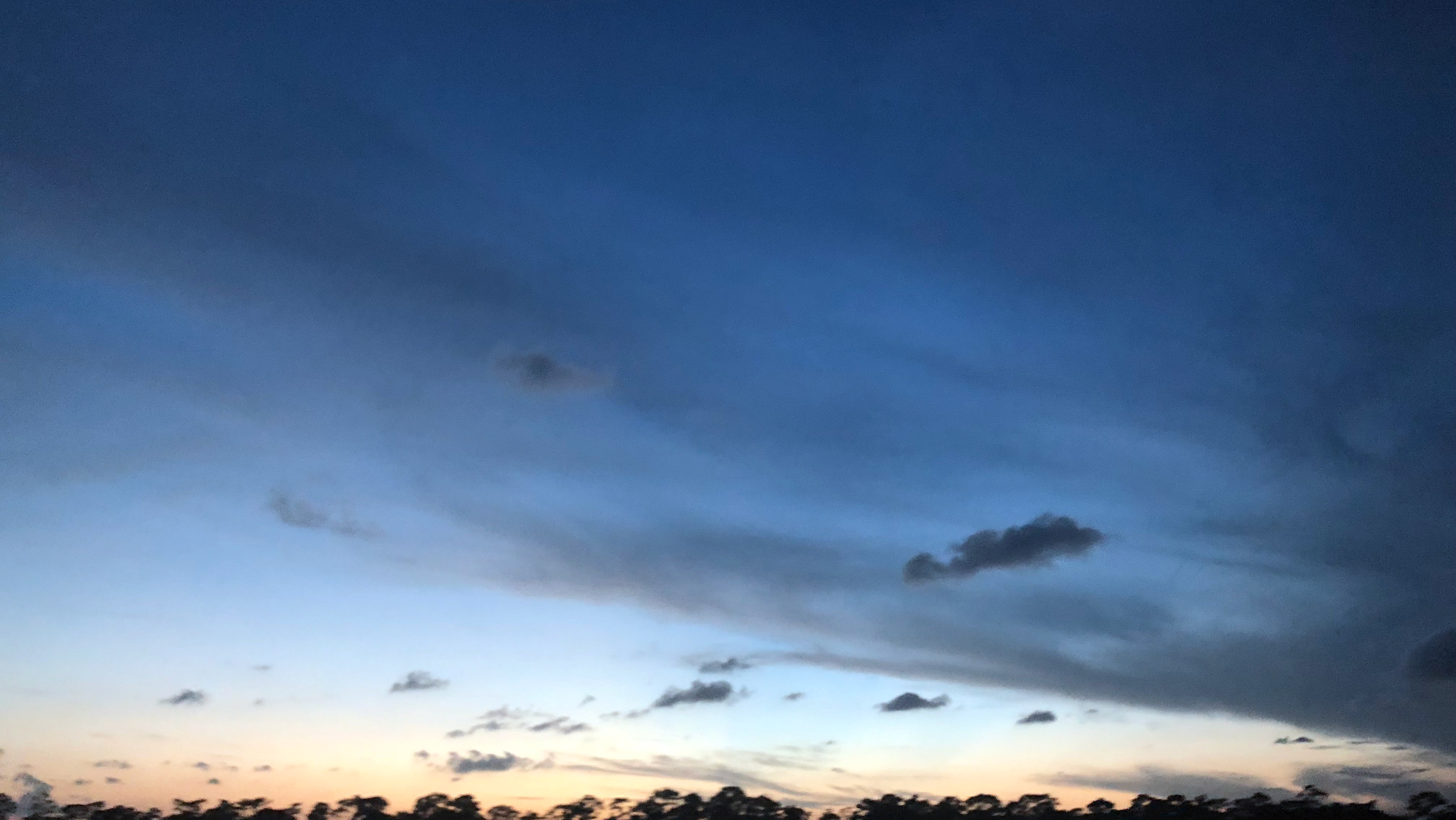
Beyond the buildings and trees is the sky. It is light blue grey, with some almost invisible thin clouds moving in motion.
A bird passes by.
Two birds fly and rest on the same position of the parapet where the previous birds rested. And they disappear.
More winds. The legs are still there. I start to question if they are really legs--maybe just two items that look like legs.
A bird passes by.
In the foreground, I see some trees covering a tilted blue aluminum roof. In the middle ground, there is a white and light brown and red parking garage--the biggest building in sight, with some shorter trees around. Further away are several taller buildings that you can see in any typical urban city--one is a white box with square dark windows; the others are totally glazed by dark blue window facades. An even taller glass tower lies further back.
Beyond the buildings and trees is the sky. It is light blue grey, with some almost invisible thin clouds moving in motion.
A bird passes by.
Two birds fly and rest on the same position of the parapet where the previous birds rested. And they disappear.
More winds. The legs are still there. I start to question if they are really legs--maybe just two items that look like legs.
A bird passes by.
(2) A view of the dorm from an ant’s perspective
Inside the brick residential hall built in 1957, my dorm sits in the corner of the first floor, with several windows facing directly towards some bushes, an oak, a pecan, and a wax-leaf ligustrum. For some reasons -- maybe there are some cracks along the floor edge or beneath the window; maybe it was the wetness of the rain season that flushed the soil and destroyed the homes of underground creatures; or maybe it was some sweet syrup my roommate accidentally dropped on the carpet and smelled strong -- one day I found a group of ants invading my bedroom. Most of them are crawling along the window aisles and close to the ground. Some are dispersed all over the room, even high up on the walls and the ceiling.
From an ant’s perspective, there are no distinctions among planes standing in different spatial dimensionalities. Whether it is the floor, the wall, or the ceiling, without the constraint of gravity due to its lightness, the ant sees all the planes as the “ground.” Depending on where the surface the ant is crawling on, the spatial feeling -- of course, in a human’s sense -- is completely different. The world is fully upside down viewing from the ceiling, while everything perpendicular to the ground becomes parallel in a sight from the wall. I wonder when it comes to the turn between two planes, especially in the corner where three planes intersect, does the ant see its turn as a transition spatially, or it simply always sees its advancement as linear?
Although ants are nearsighted and can only capture a very brief part of the room due to their tiny body sizes, they can perceive the texture of surfaces far better than I can. The smooth plastered concrete ceiling is certainly easier to climb on than the rough rug on the floor. The slippery surface of the wood closet surely feels much warmer than the metal facade of a coffee kettle. When the ant finds itself on the top of the mattress, it can explore a sea of soft, spongy areas connected and separated by nylon threads, as if it is going through a desert sloping up and down continuously. Through the tedious body movement, the ant can sense any subtle change that happens on the surface texture. Oftentimes architects build a surface of brick or marble pattern covering a concrete wall for aesthetic appeal -- when the ant traces through the gaps and bumpy surfaces, can they feel the difference between a real brick wall and a fake one?
Credit to its small size and mobility, the ant can scrutinize every detail of the bedroom to an extent that humans can hardly imagine. For example, I discover that many of them love climbing along the corner line close to the ceiling. It is an interesting spot to look over the entire room -- almost like God’s perspective. Since the offset of the corner line from the wall is very thin, I couldn’t help worrying for the ants’ safety. But again, I remind myself that the differences between surfaces don’t mean that much to the ants. They easily conquer the spatial barriers that are extremely difficult to humans. Sadly, the ants never feel tired of moving forward, so they miss the opportunity to stop for a second and enjoy the holistic view of the room that I would be curious to see.
As the architectural features have distinct meanings for the ants, so do the normal objects invented by humans. Referencing a childhood story “Two Bad Ants” where two ants lost themselves in an adventure of a house. What they discovered at last -- two comforting, long, narrow holes that reminded them of “the warmth and safety of their old underground home” -- turned out to be two electric holes full of danger. Electricity is dangerous for humans too. But from a different scale of physical presence, the human beings managed to control the potential risk embedded in the infrastructure through designs. The poor ants could easily lose their lives on many occasions in this room, whether it is the electricity, or the “deep” water in a cup, or the heat of the air conditioning. But they are not afraid of one thing that us humans dread the most for death -- gravity. The ants may have fallen on the ground, but they can always find a way to turn their backs and start crawling again.
Having said all of this, I still decide to spray the insecticide to kill them. After all, I am the owner and they are the invaders of my dorm, even though they have long existed on this land far before I came.
(3) the symbolic meaning of William Marsh Rice’s statue
In the center of the Academic Quadrangle stands the statue and tomb of William Marsh Rice, a successful businessman of the 19th century and the founder of Rice University. The bronze statue of Will Rice, sitting on top of the three-meter-high base where his ashes rested inside, has overlooked the campus for almost a decade. Its existence as a central figure in the center of the campus has formulated many cultural events, physical interactions, and political communications. While the statue’s tangible presence serves as a reminder of where this institution comes from and the generosity that made it possible, a problematic identity of Rice as a slave owner has raised intense criticisms from the student community, in amid of the social justice activism across the United States triggered by the murder of George Floyd. In a list of demands compiled by the Rice Black Student Association, students requested Rice's statue to be removed. Some others strongly suggested replacing it with an enshrinement of Raymond L.Johnson, the university's first black student who was admitted in 1964 after Rice's 'whites only' rule was overturned. Although the school administration has not offered an official response of whether removing the statue or not, other opinions persist. This controversial issue tied closely with race, equity, and community inclusion encourages us to rethink about the symbolic, cultural, and social meaning of a monument to its environment. As a form of public art, the statue not only immortalizes and beautifies a human figure who obtained a social and ethical value different from that of a century later, but also profoundly informs and impacts the physical, emotional, and intellectual lives of the community which it symbolizes and belongs to. Similar to many other human/non-human elements that we discussed in the class, the statue plays a political role in mediating the relationship between the administration and the student body, simply reflecting that of the government and the governed on a smaller scale.
On the official website of Rice University, there is little formal introduction about the statue to be found, besides a video published by the Office of Public Affairs in a series of Centennial Celebration. Narrated by the centennial historian Melissa Kean, the video introduced the history of the statue and its significance in the campus culture since 1930. The statue was commissioned to John Angel, an English sculptor, in 1927 and unveiled before the 15th Commencement of Rice University in 1930. Since then, every commencement begins with a memorial to the founder by affixing a wreath beneath the statue. As one of the main meeting places on the Rice campus, Willy’s statue has prompted many events and traditions around it, such as shouting the Gratuitous Friday Cheer and decorating it for holidays and college parties. One of the most elaborate pranks took place in 1988, when a group of engineering students turned the statue exactly 180 degrees around and made it face the Library instead of the grand Lovett Hall.
The statue also provides a resting spot for birds bustling across the campus. When I approached the statue at dusk one day during the pandemic, the campus was all quiet and empty, but I noticed some birds resting on top of Will Rice’s head. The statue, cast out of bronze, is almost twice the size of a normal human. It depicts Will Rice sitting on a chair and looking down to his right. Without much facial expression, the young, handsome man conveys a sense of solemn and calmness. The entire composition of the statue is steady and down to earth, echoing with the institution’s strict and rigorous attitude towards academics. Both of his feet sit firmly on the ground. With his head tilted slightly to the right, his right hand holds an open book towards the front, presenting knowledge to anyone who goes past him. Balancing the movement of his right hand, his left hand carries an architectural plan of Rice University, which expands downwards behind his back. The clothing of Will Rice is a typical 19th century style of businessmen, with multiple layers draping and overlapping each other naturally. On the back of the chair Will Rice sits on is an emblem, but the owls portrayed there are of a style seen only on this statue and nowhere else. Beneath the statue is Will Rice’s tomb, which also serves as a base that elevates the statue from the ground. On the front side of the granite base is his name and living date, beneath another emblem of the university and two torches. Several different emblems and latin scripts decorate the other three sides.
The statue of William Marsh Rice is not the only statue or public art on the campus. In front of Keck Hall stands the bronze statue of Edgar Odell Lovett, the first president of Rice University. It was commissioned on the occasion of the University’s centennial and a gift made by several alumnus, faculties, and family members. Although it is a standing figure, the sculpture is on a smaller scale than Rice’s and the base is lower. As part of the academic seal “letters, science and art,” the arts have played an integral role in the teaching, research, and public programs throughout the campus. Another bronze sculpture, The Sisters designed by the Swedish artist Carl Milles, is the first work of public art gifted to Rice. Dancing above fountain pools in the garden between Jones and Brown Colleges, this work depicts two sisters meeting in heaven. Besides the statues, artworks such as Geoffrey Dashwood’s Monumental Barn Owl, Michael Heizer’s 45°, 90°, 180°, and Jim Love’s Jack distribute across the campus. These sculptures usually stand in a courtyard adjacent to academic or residential buildings, dedicating to members who have contributed significantly to the Rice community, or simply symbolizing a form of knowledge itself. Students often go past these spots between classes, and they tend to gather over there for academic or entertaining group events.
The public arts at Rice University are usually humble and quiet, sometimes even “invisible”. Nevertheless, they shape the public space and community value in a significant way. Those statues, designed in rigid gestures and dark colors, reflect the unassuming academic atmosphere promoted by the institution and remind the students of such values as they go past or gather around them. Although not listed in the public art page of Moody Center for The Arts, Rice’s statue undeniably holds the most important status. Will Rice, the man who gave his name and heritage to the school and established the fundamental academic doctrine of “letters, science and art,” thus becomes a symbol of the school itself. When I search for images of Rice University online, most of the pictures entail the Academic Quadrangle, in which the statue stands in the right middle. In the early stage when very few buildings were constructed, the magnificent Lovett Hall represented the entire image of the school and the ambition of making it one of the most notable universities in the United States. The statue and the meditteranian-style central quad came right after. Therefore, the establishment of the statue has a powerful meaning in shaping the architectural and landscape planning of the campus. The library sits right at the other end of the quad. Many colleges and academic buildings stem out, gradually forming the campus landscape we perceive today. The public space centering around the statue not only becomes the first impression of any visitors who come to Houston and Rice University, but also gives symbolic memories to all the freshmans and graduates who just went through the Lovett Hall and begin a new chapter in their life.
Geographically speaking, the statue of Will Rice is located in the center of the quad, which also sits in the center of the school. However, in the democratic context of the United States, the physical centrality does not imply any statement of central power and authority. In communist regimes, colossal statues of Stalin, Lenin, Mao, and Kim Il Sung serve to remind the citizens of the government's unquestionable authority. Here, on the contrary, the values of statues are often questioned and can be accused by the public. Since many individuals have the right of building monuments, the sentiment of commissioning and designing such monuments sometimes can be biased and narrow, not reflecting the history and values of the entire community. Thus, the identity of Will Rice as a slave owner and the problematic history of Rice University as a white-only institution until 1964 undoubtedly raise many concerns and criticisms, especially during the national movement of anti-racism. During the protests following the murder of George Floyd, many monuments to the Confederate States of America and to individuals involved in the genocide of indigenous peoples are defaced, burned or destroyed. Throughout the history of any nation, the removal and destruction of monuments occur time and time. In some cases, it involves a political decision in eradicating the historical existence of another person. In others, it attempts to deny one or several parts of the values a monument stands for, when they are in stark opposition to the current ideals. The debate we encounter now relates to the latter. But different from other cases we’ve seen across the nation, the removal of Rice’s statue might eradicate an essential part of the institution’s culture and history.
According to an email from President Leebron and Provost DesRoches, a diverse group of students and alumni hold different opinions regarding this issue. Zhang, a Chinese alumni graduated in 2019, wrote a letter to the president and shared it on social media. Titled “Please be careful about removing Willy’s statue,” Zhang expressed his concern of whether removing the statue truly embraces equity and inclusiveness of the entire student population. By the time Will Rice founded the institution and his statue was built, anyone but white students was excluded. However, over the past century, Rice University has changed its policies and becomes one of the most diverse universities in the United States, welcoming people from all over the globe. The problematic slavery history and white-supremacy belief only reflect the morals of a different societal context a century ago. “Should we judge a historical figure based on our current value?” Zhang asked, and more importantly, “What best represents the sentiment of the entire student population for today?” As an international student, I don’t support the removal of the statue. The Rice identity represented by the statue unites personal beings like me and ties the community together. Rather than taking it down and exaggerate the racial difference, maybe it is time for us to recontextualize the statue and add greater meanings of equity and inclusion to it through other alternatives.
Beyond the political debate generated within itself, the statue has long played a role of mediating between the administration and the student body. Because of its geographic and symbolic prominence, the statue is always a popular spot for student protests. Most recently in September 2019, in response to an alumna’s traumatic experience of sexual assault and with Student Judicial Programs, student protestors covered the statue with cutouts of the newspaper and placed a poster at its foot. After the police quickly removed the signages, protesters directly drew distinguishable signs on the granite with chalks. The deliberate destruction and signage display are similar to the act of graffiti protests on an urban scale. The statue somehow became a connecting point between the students and the administration, and quickly gathered a lot of attention even from the local newspaper. Later, the administration responded with an apology and promise of institutional changes. Through this example, we can see that the statue plays a critical role in the campus spatial and cultural environment, not only as a spot for official events such as the graduation ceremony.
The cultural meaning of Rice University transcends the statue from a human being into a symbol that brings people together. As students, faculties, staff, and visitors pass by or gather in the quad, they are unconsciously influenced by the solemn and unassuming atmosphere created by the statue. That is why we need public arts. As an indivisible part of our academic, social, and cultural life, these arts fundamentally shape our understanding of public space and communal values. If we really take down the statue, how will its absence change everyone’s perception of Rice campus? What, or who, will be a good substitute to fill the void of its aesthetics and cultural role? Shall we reconsider about the naming of public space -- the school, the street, and the village -- after the same person as well? The removal debate has raised many more questions upon itself. While we are waiting for an official answer, we should contemplate, as a community, what Rice’s legacy can really mean to make today’s diversity and inclusion more possible.
Bibliography
Britto, Brittany. “Rice University Apologizes for Sexual Assault Discipline Blunder.” HoustonChronicle.com, September 28, 2019. https://www.houstonchronicle.com/local/education/campus-chronicles/article/Rice-University-apologizes-for-sexual-assault-14474631.php.
Moody Center for The Arts. “Bruce Wolfe,” May 25, 2017. https://moody.rice.edu/art/bruce-wolfe.
“List of Monuments and Memorials Removed during the George Floyd Protests - Wikipedia.” Accessed June 28, 2020. https://en.wikipedia.org/wiki/List_of_monuments_and_memorials_removed_during_the_George_Floyd_protests.
Maguire, Yoseph. “Replace Willy’s Statue with Johnson.” The Rice Thresher. Accessed June 28, 2020. https://www.ricethresher.org/article/2020/06/replace-willys-statue-with-johnson.
Roos, Dave. “How Removing Public Monuments Works.” HowStuffWorks. Accessed June 28, 2020. https://science.howstuffworks.com/engineering/structural/removing-public-monuments.htm.
Ruth, David. “Centennial Video Series: Willy’s Statue.” Rice University News and Media Relations. Accessed June 28, 2020. https://news.rice.edu/2012/09/07/centennial-video-series-willys-statue-2/.
Moody Center for The Arts. “Bruce Wolfe,” May 25, 2017. https://moody.rice.edu/art/bruce-wolfe.
“List of Monuments and Memorials Removed during the George Floyd Protests - Wikipedia.” Accessed June 28, 2020. https://en.wikipedia.org/wiki/List_of_monuments_and_memorials_removed_during_the_George_Floyd_protests.
Maguire, Yoseph. “Replace Willy’s Statue with Johnson.” The Rice Thresher. Accessed June 28, 2020. https://www.ricethresher.org/article/2020/06/replace-willys-statue-with-johnson.
Roos, Dave. “How Removing Public Monuments Works.” HowStuffWorks. Accessed June 28, 2020. https://science.howstuffworks.com/engineering/structural/removing-public-monuments.htm.
Ruth, David. “Centennial Video Series: Willy’s Statue.” Rice University News and Media Relations. Accessed June 28, 2020. https://news.rice.edu/2012/09/07/centennial-video-series-willys-statue-2/.
2020-06-09 essay for ANTH summer class City / Culture